

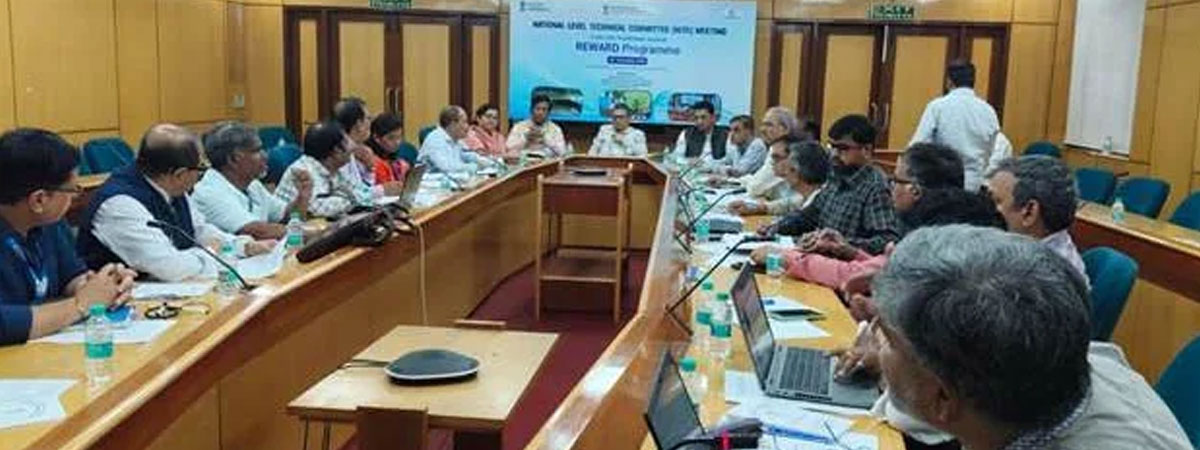
The National Rainfed Area Authority (NRAA) under the Ministry of Agriculture and Farmers Welfare organised a National Level Technical Committee (NLTC) meeting on September 22 at the NASC Complex, New Delhi, to discuss watershed development and management under the REWARD (Rejuvenating Watersheds for Agricultural Resilience through Innovative Development) programme.
The meeting was chaired by Dr. Chandra Shekhar Kumar, IAS, Chief Executive Officer, NRAA, and brought together senior government officials, scientists, technical experts and representatives from institutions working in watershed management.
Around 45 participants attended the meeting, including representatives from the Department of Land Resources, ICAR, State Level Nodal Agencies of Odisha and Karnataka, agricultural universities, IITs, NGOs, technical partners and REWARD programme teams.
Focus on National Technical Guidelines
A major focus of the meeting was the draft National Technical Guidelines (NTG) for watershed development. The committee discussed the technical provisions and recommendations proposed in the draft and examined how evidence and data generated under the REWARD programme could help strengthen the guidelines.
The discussions also emphasised the importance of integrating Land Resource Inventory (LRI) data with hydrological information. Such integration can help improve watershed planning and enable decisions to be based on scientific and field-level evidence.
The proposed guidelines are intended to provide a technical framework for future watershed development under the Watershed Development Component of Pradhan Mantri Krishi Sinchayee Yojana (WDC-PMKSY) 3.0.
Strengthening Rainfed Agriculture
The meeting highlights the growing emphasis on science-based and data-driven watershed management in India’s rainfed regions.
Effective watershed development can support better water conservation, soil and natural resource management, agricultural productivity and climate resilience. It can also help strengthen the livelihoods of communities dependent on rainfed agriculture.
The participation of government agencies, research institutions, technical organisations and field-level stakeholders reflects the importance of collaboration in developing practical and scientifically sound approaches to watershed management.
The initiative is expected to contribute to a more integrated approach to watershed planning, with water, land, agriculture and local resources considered together for sustainable development of rainfed areas.
Comment here